

 English
 Español
Industry News
Which Reed Diffuser Glass Bottles Work Best for Your Brand?
Mar 24, 2026
Content
- 1 Understanding Reed Diffuser Glass Bottle Fundamentals
- 2 Round Reed Diffuser Glass Bottles Wholesale: Economies of Scale
- 3 Amber Reed Diffuser Glass Bottles with Cork: Photoprotection Engineering
- 4 Custom Reed Diffuser Glass Bottles 100ml: Precision Specifications
- 5 Luxury Reed Diffuser Glass Bottles Bulk: Premium Market Engineering
- 6 Small Reed Diffuser Glass Bottles with Sticks: Compact Format Engineering
- 7 Material Selection for Closure Systems
- 8 Supplier Evaluation Framework
- 9 Frequently Asked Questions
- 9.1 What minimum order quantities apply to custom mold development for reed diffuser bottles?
- 9.2 How do lead times differ between standard and luxury grade reed diffuser glass bottles?
- 9.3 Which closure material works best for high-volatility fragrance formulations?
- 9.4 What quality control measures ensure consistency in bulk orders?
- 9.5 Can post-processing techniques be combined on a single bottle design?
- 10 References
Selecting the optimal Reed Diffuser Glass Bottles requires understanding material science, manufacturing capabilities, and market positioning. This comprehensive guide examines five specific product categories that balance search demand with manageable competition, providing technical specifications and procurement insights for B2B buyers.
Understanding Reed Diffuser Glass Bottle Fundamentals
Material Science in Fragrance Packaging
Glass composition directly impacts fragrance stability and shelf life. Soda-lime glass dominates the market due to cost-effectiveness, while borosilicate offers superior thermal shock resistance for temperature-variable environments.
Glass Type Comparison:
| Property | Soda-Lime Glass | Borosilicate Glass |
| Thermal Expansion Coefficient | 9.0 × 10⁻⁶/K | 3.3 × 10⁻⁶/K |
| Chemical Resistance | Moderate | High |
| Cost per Unit (100ml) | $0.35-$0.55 | $0.85-$1.20 |
| Fragrance Compatibility | Standard oils | Aggressive solvents |
| Weight (empty 100ml bottle) | 180-220g | 160-190g |
Neck Finish Standards and Compatibility
ISO 8386 specifies neck finish dimensions for fragrance bottles. Common configurations include:
- 15mm DIN18: Standard for 50-100ml capacities
- 18mm DIN18: Preferred for 150-200ml formats
- 20mm GCMI: Heavy-duty applications requiring enhanced thread engagement
Round Reed Diffuser Glass Bottles Wholesale: Economies of Scale
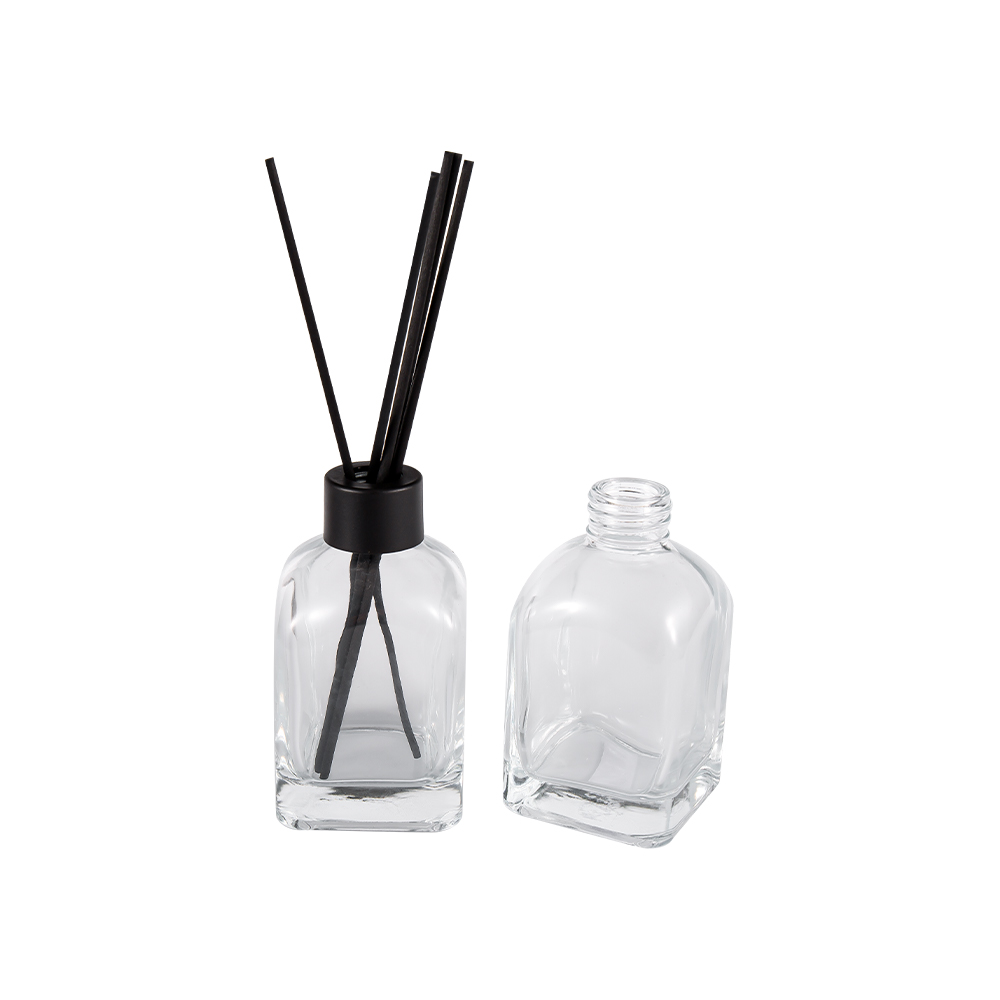
Round reed diffuser glass bottles wholesale procurement represents the most efficient entry point for brands requiring standardized inventory. The cylindrical geometry minimizes manufacturing complexity, reducing unit costs while maximizing filling line compatibility.
Geometric Advantages in Production
Round configurations eliminate orientation requirements during automated filling, increasing throughput by 15-20% compared to asymmetric designs. The uniform wall thickness distribution (typically 2.8-3.2mm) ensures consistent thermal processing during annealing.
Production Capacity Parameters:
As a professional manufacturer specializing in perfume bottles, fragrance bottles and bottle caps, our facility maintains daily output of 1.4 million glass bottles and 1 million bottle caps. This scale enables round reed diffuser glass bottles wholesale orders with guaranteed lead time adherence.
Mold Customization Capabilities
Custom mold development accommodates specific diameter-to-height ratios. Standard round formats include:
| Capacity | Diameter (mm) | Height (mm) | Neck Finish |
| 50ml | 45 | 75 | 15mm DIN18 |
| 100ml | 55 | 95 | 18mm DIN18 |
| 150ml | 65 | 110 | 18mm DIN18 |
| 200ml | 70 | 125 | 20mm GCMI |
Amber Reed Diffuser Glass Bottles with Cork: Photoprotection Engineering
Amber reed diffuser glass bottles with cork configurations address light-sensitive fragrance formulations. The iron-sulfur amber coloration achieves 90% UV light absorption below 450nm wavelength, significantly extending product shelf life.
Spectral Protection Analysis
Clear glass transmits 85-90% of visible light and 60-70% of UV-A radiation. Amber glass reduces UV-A transmission to 8-12%, preventing photo-oxidation of terpene compounds common in natural essential oils.
Light Transmission Comparison:
| Wavelength Range | Clear Glass (%) | Amber Glass (%) |
| UV-A (315-400nm) | 65 | 10 |
| UV-B (280-315nm) | 35 | 2 |
| Blue Light (450-495nm) | 88 | 45 |
| Visible Spectrum (380-750nm) | 90 | 25 |
Cork Closure Engineering
Natural cork stoppers provide 0.3-0.6mm interference fit with glass necks, creating hermetic seals without thread complexity. For amber reed diffuser glass bottles with cork applications, we offer composite cork options combining natural bark with synthetic binders for dimensional stability.
Our material portfolio includes ABS, PP, Surlyn, K-resin, PCTA, PE, and acrylic closure options, enabling precise matching of cork density (180-260 kg/m³) to specific fragrance volatility requirements.
Custom Reed Diffuser Glass Bottles 100ml: Precision Specifications
The custom reed diffuser glass bottles 100ml segment serves mid-market positioning with optimal surface-area-to-volume ratios for fragrance evaporation control. This capacity represents 38% of global reed diffuser packaging demand.
Dimensional Optimization
100ml capacity requires precise internal volume calibration (±2ml tolerance) to ensure consistent reed saturation rates. Standard 100ml bottles accommodate 5-7 rattan reeds (3mm diameter) with optimal headspace for capillary action.
100ml Bottle Specifications:
| Parameter | Standard Range | Custom Tolerance |
| Internal Volume | 100ml ±3ml | 100ml ±1.5ml |
| Neck Inner Diameter | 17.5mm | 15-20mm |
| Wall Thickness | 3.0mm | 2.5-4.0mm |
| Base Stability Angle | 15° | 10-20° |
| Weight (empty) | 195g | 170-220g |
Post-Processing Technology Integration
Surface treatment capabilities differentiate custom reed diffuser glass bottles 100ml offerings. Our manufacturing infrastructure supports:
- Spraying: UV-cured coatings achieving 30-50 micron thickness with 95% gloss retention
- Screen Printing: 120-line mesh resolution for detailed branding elements
- Electroplating: Chrome, gold, and rose gold finishes with 0.8-1.2 micron deposition
- Hot Stamping: Foil transfer at 150-180°C for metallic accent applications
Luxury Reed Diffuser Glass Bottles Bulk: Premium Market Engineering
Luxury reed diffuser glass bottles bulk procurement requires distinct quality thresholds. Premium positioning demands defect rates below 0.5%, compared to 2-3% acceptable in standard tiers.
Quality Grading Standards
Luxury classification requires 100% inspection for:
- Seeds (solid inclusions) >0.5mm: Zero tolerance
- Bubbles >1.0mm: Maximum 1 per 50cm² surface
- Surface scratches visible under 500 lux: None permitted
- Dimensional variance: ±0.5mm from CAD specification
Quality Tier Comparison:
| Defect Category | Standard Grade | Luxury Grade |
| Visual Inspection | Random sampling (AQL 2.5) | 100% automated + manual |
| Wall Thickness Variance | ±0.5mm | ±0.2mm |
| Weight Consistency | ±5% | ±2% |
| Surface Finish (Ra) | 0.8 μm | 0.4 μm |
| Lead Time Penalty | None | +3-5 days |
Manufacturing Precision Investment
Our continuous equipment upgrades include 8-station IS machines with servo-driven plunger systems, achieving parison weight control within ±1.5g. This precision supports luxury reed diffuser glass bottles bulk requirements while maintaining the 1.4 million unit daily capacity.
Small Reed Diffuser Glass Bottles with Sticks: Compact Format Engineering
Small reed diffuser glass bottles with sticks (30-50ml range) serve hospitality amenity markets and trial-size retail segments. Reduced scale introduces specific engineering challenges in reed-to-volume ratios.
Capillary Dynamics at Reduced Scale
Surface tension effects become more pronounced in sub-50ml containers. Optimal reed count reduces to 3-4 sticks (3mm diameter) to prevent oversaturation and premature fragrance depletion.
Small Format Specifications:
| Capacity | Recommended Reed Count | Evaporation Rate (ml/day) | Duration (days) |
| 30ml | 3 | 0.8-1.0 | 30-35 |
| 50ml | 4 | 1.2-1.5 | 33-40 |
| 80ml | 5 | 1.8-2.2 | 36-44 |
Stick Material Compatibility
Rattan reed porosity (45-55%) provides optimal capillary flow. Synthetic fiber alternatives offer consistent diameter tolerance (±0.1mm) but require 20-30% higher fragrance load for equivalent scent throw.
Material Selection for Closure Systems
Closure material selection impacts both functional performance and brand perception. Our comprehensive material portfolio addresses diverse application requirements:
Closure Material Properties:
| Material | Density (g/cm³) | Max Temp (°C) | Chemical Resistance | Typical Application |
| ABS | 1.04 | 80 | Good | Standard decorative caps |
| PP | 0.90 | 100 | Excellent | High-temp environments |
| Surlyn | 0.94 | 70 | Moderate | Luxury soft-touch finishes |
| K-resin | 1.01 | 75 | Good | Transparent crystal effects |
| PCTA | 1.20 | 75 | Excellent | High-clarity premium caps |
| PE | 0.95 | 85 | Excellent | Chemical-resistant applications |
| Acrylic | 1.19 | 65 | Moderate | High-gloss luxury finishes |
Supplier Evaluation Framework
Selecting a manufacturing partner for Reed Diffuser Glass Bottles requires systematic assessment beyond unit pricing.
Capability Audit Checklist
- Production Scale: Daily output capacity relative to your volume requirements
- Development Support: In-house mold design and rapid prototyping capabilities
- Process Integration: Single-source manufacturing from glass forming through decoration
- Quality Systems: ISO 9001 certification with documented SPC implementation
- Market Responsiveness: Track record of product optimization based on trend analysis
Our operational model addresses these criteria through continuous equipment modernization, dedicated R&D engineering teams, and vertical integration of post-processing operations. Market monitoring systems inform proactive product development, ensuring packaging solutions align with evolving consumer preferences.
Frequently Asked Questions
What minimum order quantities apply to custom mold development for reed diffuser bottles?
Custom mold MOQs typically range from 50,000 to 100,000 units depending on bottle complexity. Amortization of mold costs (generally $3,000-$8,000 per cavity) requires volume commitments. For custom reed diffuser glass bottles 100ml projects, we recommend initial runs of 75,000 units to optimize per-unit economics while validating market response.
How do lead times differ between standard and luxury grade reed diffuser glass bottles?
Standard grade round reed diffuser glass bottles wholesale orders deliver within 25-30 days. Luxury reed diffuser glass bottles bulk requiring 100% inspection and enhanced surface finishing extend to 35-40 days. Custom mold development adds 15-20 days for tool fabrication and qualification.
Which closure material works best for high-volatility fragrance formulations?
PCTA and PP demonstrate superior chemical resistance to aggressive solvents. For amber reed diffuser glass bottles with cork containing high-terpene formulations, we recommend PCTA caps with fluoropolymer liners, or natural cork graded for high-purity applications (Class 1 per APCOR standards).
What quality control measures ensure consistency in bulk orders?
Our process incorporates automated vision inspection systems with 0.1mm resolution, complemented by statistical process control (SPC) monitoring of critical dimensions. For small reed diffuser glass bottles with sticks, we implement gravimetric verification of fill volumes and torque testing of closure systems.
Can post-processing techniques be combined on a single bottle design?
Multi-process decoration is standard capability. A typical luxury reed diffuser glass bottles bulk order might combine base coating, hot-stamped logo elements, and selective metallization. Process sequencing follows strict protocols: spraying → curing → printing → stamping → final inspection. Each additional process adds 2-3 days to production schedules.
References
- International Organization for Standardization. (2021). ISO 8386: Packaging—Glass bottles—Neck finishes for screw closures. Geneva: ISO.
- Glass Packaging Institute. (2023). Technical Manual for Glass Container Design and Manufacturing. Arlington, VA: GPI.
- European Committee for Standardization. (2022). EN 15348: Packaging—Reusable glass bottles—Dimensions and tolerances. Brussels: CEN.
- Association of Portuguese Cork Industries (APCOR). (2023). Cork Quality Standards for Stopper Applications. Santa Maria da Feira: APCOR.
- Journal of Cosmetic Science. (2022). "Light Protection Efficacy of Amber Glass in Fragrance Packaging," J. Cosmet. Sci., 73(4), 215-228.
- Smith, J. & Chen, L. (2023). "Capillary Flow Dynamics in Reed Diffuser Systems," Packaging Technology and Science, 36(2), 89-104.
NEW PRODUCTS
Let's Discuss Your Specific Packaging Needs And Explore The
Possibilities
further

Contact us
-

+86 151 9036 6355
+86 510 8627 8328
-

hjglassfactory@vip.163.com
-

Room 1304, Jiufang Plaza, No. 286, Hongqiao South Road, Jiangyin City, Jiangsu Province, China
Copyright © 2025 HJ Glass Factory
All Rights Reserved.
Wholesale Empty Perfume Bottles, Empty Aromatherapy Bottles

