English
 Español

Industry News
Home / News / Industry News / How to Choose the Right Perfume Bottle for Your Brand: A Packaging Guide
Oct 19, 2026
Content
A 50 ml fragrance can fail its first sample review for a detail that never appears on a mood board: the neck finish does not match the crimp pump the brand already stocks. Fill volume, closure geometry, glass weight and cap material decide whether a perfume bottle order ships on schedule, and all four are locked in months before the artwork is approved.
Choosing the right perfume bottle for your brand is a packaging engineering decision first and a design decision second. HJ Glass Factory, the export brand of Jiangyin Zhuoyun Trading Co., Ltd., produces up to 1.4 million glass bottles and 1 million caps per day, which means the questions brands ask most often, about capacity, closure fit and decoration durability, already have production-floor answers rather than theoretical ones.
Set the fill volume before you set the silhouette, because volume drives glass weight, carton footprint and freight cost per unit. Brands that start with a shape and work backwards usually end up re-tooling the carton and the closure at the worst possible moment in the launch calendar.
| Capacity | Best fit | What to plan for |
| 15-25 ml | Travel sprays, discovery sets, gift-with-purchase | Highest decoration cost per ml and a very small print area |
| 30 ml | Eau de toilette entry SKU and subscription refills | Most crowded shelf slot, so cap differentiation matters most |
| 50 ml | Core retail size and the main revenue driver | Best balance of glass weight, shelf presence and freight |
| 100 ml | Eau de parfum flagship and refillable formats | Thicker wall and heavier carton, so freight rises fastest |
Two rules save time here. First, keep a first order to two capacities rather than four, since each capacity usually needs its own cap tooling and its own carton dieline. Second, if a 30 ml and a 50 ml will share one cap, specify the cap before you choose the bottles, not after.
Capacity mix in a typical four-SKU fragrance launch
Illustrative planning mix based on common fragrance launch structures. Replace the shares with your own channel data before you place tooling orders.
A clear 30 ml glass bottle with a glossy black cap keeps decoration simple and still reads as a finished product on a crowded shelf, which is why it is the most common first SKU for new fragrance houses.
A perfume bottle only works when the neck, the pump and the cap are specified as one system. Confirm the neck finish before you approve a render, because no decoration can rescue a closure that leaks.
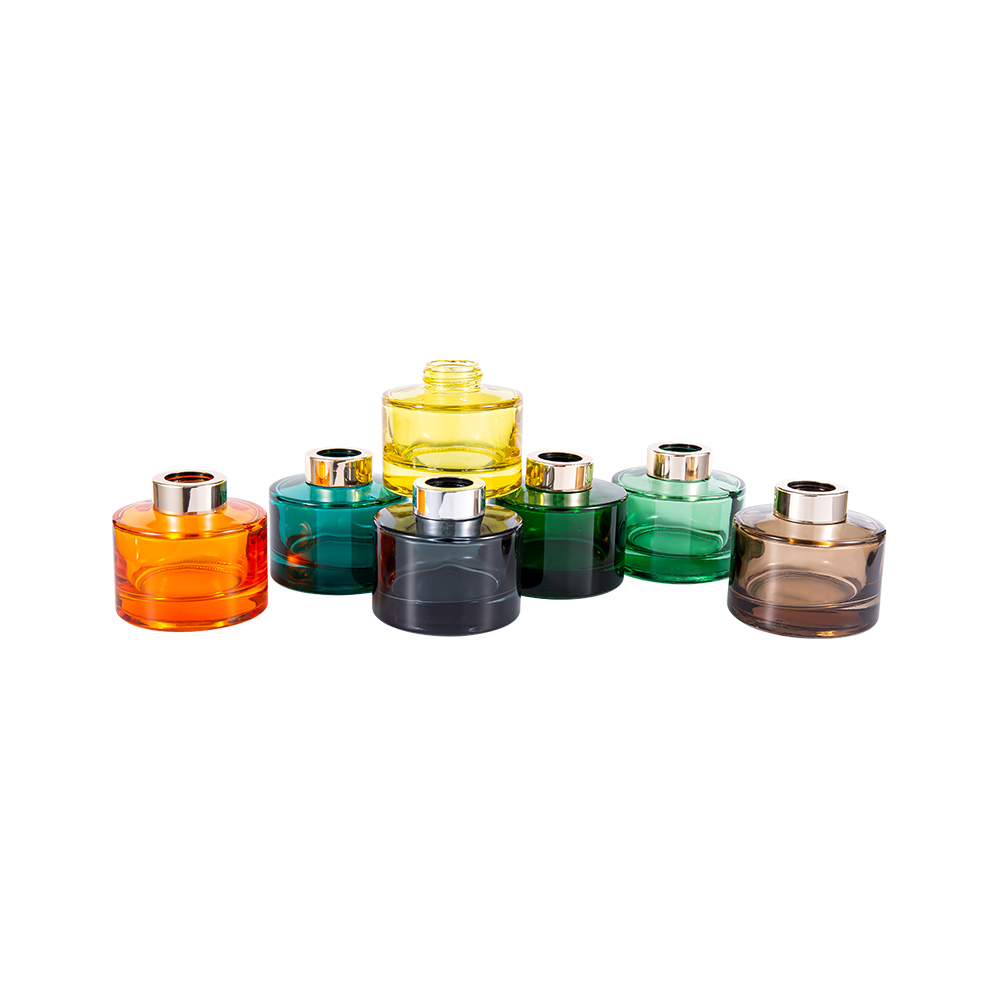
Fine fragrance pumps are normally built for a 15 mm crimp neck, travel sizes and refillable aluminium formats typically use screw closures, and diffuser or aromatherapy formats commonly use a 24 mm screw neck. If your contract filler already owns crimping heads for one standard, an unusual neck finish turns into a new equipment cost rather than a bottle cost, and that line item rarely appears in the original quote.
Specify the neck finish, the pump and the cap as a single system. Sourcing those three parts from three suppliers is how leak complaints begin, and the bottle usually takes the blame.
A short reference on the different types of caps and sprayers is worth reading before you brief a supplier, because crimp collars, screw pumps and atomisers each carry their own tolerance expectations.
Heavier glass does not automatically read as more expensive, but it always costs more to ship. A standard 50 ml fragrance bottle typically sits between 80 g and 140 g depending on wall thickness, and that spread changes freight far more than most brands expect.
Wall thickness also affects function. A thinner wall needs tighter dimensional tolerance at the neck, because the crimp has less material to bite into, and uneven wall distribution is one of the most common causes of leaking crimp collars. When weight and tolerance conflict, choose tolerance every time.
Colour coating adds another variable. A coated bottle hides cord marks and small surface variations that clear flint glass would expose, which is why coated decors often pass quality review with a higher yield than transparent ones.
Choose a decoration for how it behaves after twelve weeks in a warehouse, not for how it looks in a studio photograph. Surface treatments differ far more in durability than they do in appearance.
| Decoration | Durability | Where it works best |
| Frosting | Permanent, etched into the glass surface | Minimal, ingredient-led brand identities |
| Spray coating | Strong, but chips at shoulders and edges | Colour-block SKUs with simple geometry |
| UV coating | High gloss with added light protection | Fragrances sensitive to light exposure |
| Hot stamping | Moderate, rubs under repeated friction | Logos and thin metallic accents |
| Screen printing | High, resists everyday handling | Multi-colour artwork and text-heavy packs |
| Pressure-sensitive label | Lowest of the group, edges lift over time | Short runs and market tests |
Two practical tests separate decoration routes before you commit. A tape test on a coated sample shows whether the coating has bonded to the glass or is merely resting on it, and a rub test on hot stamped foil shows how the mark behaves when cartons slide against each other in transit.
The cap is the part of the pack a customer touches first, and material choice sets the perceived price tier faster than any label. Match the cap to the bottle weight, never the other way around.
Surlyn and acrylic
ABS, PP, K-resin and PCTA
A heavy Surlyn cap on a thin-walled bottle makes the pack top-heavy, which increases tip-over on retail shelves and damage in transit. Balance between glass and cap matters more than absolute weight, and it is one of the first things a packaging engineer checks on a sample.
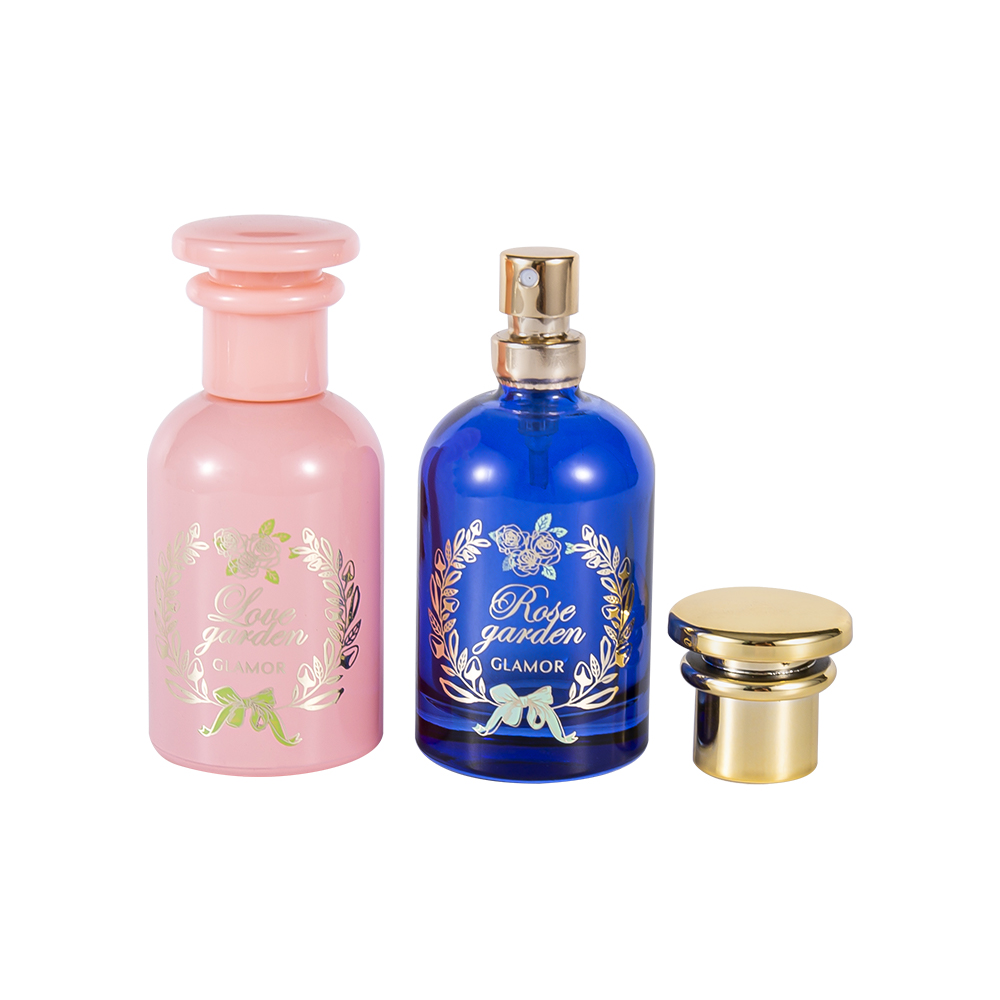
HJ Glass Factory works with cap materials including ABS, PP, Surlyn, K-resin, PCTA, PE and acrylic, so the closure specification can follow the price tier instead of the other way around. You can review perfume bottle sets by capacity to see how each combination is normally paired.
The sequence below prevents the two most expensive mistakes in fragrance packaging: tooling a custom mold before the closure is confirmed, and approving decoration before a wear test has been run.
Fix the fill volume and the concentration
Match the capacity to the concentration and the price tier, and cap the first order at two sizes.
Specify the neck finish, pump and cap as one system
Confirm the crimp or screw standard against your filler equipment before any 3D render is approved.
Decide between a stock mold and a custom mold
A custom mold buys differentiation and adds lead time. Choose it only when the shape itself carries the brand.
Shortlist two decoration routes, not five
Compare them on durability and cost per unit, then run a tape or rub test on physical samples.
Match the cap material to the bottle weight
Aim for a balanced pack that stands straight and feels deliberate when someone picks it up.
Approve a pre-production sample before tooling
Check neck dimensions, print registration and coating coverage on the actual production line.
The minimum is set by the mold and the decoration, not by the bottle alone. Stock shapes ship in smaller quantities than a newly cut mold, and a new coating or hot stamp step usually raises the floor further because setup time is fixed. Ask for the minimum to be quoted together with the tooling cost so the true entry price is visible.
Budget the timeline in two parts: mold fabrication and then sampling. Sampling is where most schedules slip, because a neck tolerance correction or a coating adjustment restarts the approval loop. Request a written schedule that separates tooling, first sample and production, and hold your launch date against the production milestone rather than the tooling one.
Surlyn and acrylic generally feel the most premium because they are heavier and can be produced without a visible parting line. ABS and PP close the gap quickly when they carry a matte or soft-touch finish, and they cost less. The deciding factor is the ratio between cap weight and bottle weight, not the cap material on its own.
Not automatically. Glass cost per ml typically falls with a larger bottle, but freight, carton volume and breakage risk all rise, and a 100 ml pack often needs a thicker wall to stay stable when filled. For most brands, the 50 ml size remains the most efficient unit to produce and ship, while the 100 ml size exists to raise the perceived value of the line.
Before you brief any supplier, write down four numbers: fill volume, neck finish, target unit weight and cap material. Those four values decide roughly eighty percent of the cost, the lead time and the quality risk of a perfume bottle project.


+86 151 9036 6355
+86 510 8627 8328

hjglassfactory@vip.163.com

Room 1304, Jiufang Plaza, No. 286, Hongqiao South Road, Jiangyin City, Jiangsu Province, China
Copyright © 2025 HJ Glass Factory
All Rights Reserved.
Wholesale Empty Perfume Bottles, Empty Aromatherapy Bottles