English
 Español
Industry News
Home / News / Industry News / Refillable Glass Perfume Bottles: How Refillable Design Meets Luxury Aesthetics
Sep 28, 2026
Content
Every 50ml glass perfume bottle sold in a single-use format carries roughly 35 to 40 grams of glass, a spray pump, and a cap. When that entire package is discarded after one use, the material footprint per milliliter is at its maximum. A refillable glass perfume bottle changes the equation by keeping the heaviest component, the glass shell, in service, so the per-use packaging weight can drop by more than half.
Fragrance houses in Europe and North America have introduced refillable formats at a steady pace since 2020, and demand from retailers and consumers continues to grow. The trend is driven by EU packaging regulations and by consumers who check the environmental footprint of the bottle in their hand. For a package manufacturer, that means the refillable design must deliver on both fronts at once: a measurable sustainability improvement and an unbroken premium experience. When HJ Glass Factory develops a refill-ready bottle for a fragrance brand, the first design question is not how to cut packaging cost, but how to preserve the brand's aesthetic identity across every refill cycle.
A refillable bottle differs from a standard flacon in its closure interface and refill path, not in its silhouette. The glass shell stays with the consumer; the inner refill cartridge or bulk refill container carries the perfume concentrate. On a typical refillable model, the collar either unscrews, twists off, or releases with a press-and-lock mechanism, allowing the user to insert a fresh cartridge or pour from a refill bottle without breaking the glass.
HJ Glass Factory produces refillable perfume bottle sets across capacities from 30ml to 100ml, using neck finishes that accept standard crimp and screw pumps. The refillable system must work on the production line as well as in the consumer's hand. The key parameters are:
Each parameter is verified during tooling trials before a refillable design reaches mass production. The strongest refillable programs pair a single durable bottle with a refill cartridge that is equally thoughtful in its design, so the consumer's first experience with the refill feels as intentional as the bottle launch. A refillable design shifts the economics of packaging from a one-time cost to a recurring, lower-cost relationship with the customer.
Refillable glass packaging delivers a 30 to 45 percent reduction in combined material footprint per filled unit when compared with a single-use bottle of the same capacity. The glass shell is reused across multiple fill cycles, so only the thin refill cartridge and the pump are consumed each time. This is the strongest sustainability argument for a refillable flacon, and it holds true only when the glass body is engineered to survive repeated handling and cleaning.
The comparison in the chart below uses normalized values for a 50ml format. Material per filled unit drops from 100 to 62; CO2 from 100 to 71; energy from 100 to 74; packaging waste from 100 to 42.
Normalized values for a 50ml refillable glass perfume bottle format.
Glass is endlessly recyclable without purity loss, and as a natural mineral it consumes less energy during raw material processing than virgin plastic resin. The energy-intensive step is melting the glass; refill design spreads that cost across multiple uses, which is where the payback comes from. Actual results depend on refill weight, cap complexity, distance to market, and the number of refill cycles, which is why a sustainability claim has to survive scrutiny from customers, regulators, and environmental auditors.
A glass refill bottle can look every bit as premium as a traditional fragrance bottle when the finishing is designed around the refill mechanism. The luxury feel comes from the same decorative tools used on any high-end flacon: UV coating, gradient color coats, hot stamping, frosted matte, embossing, and metalized caps. None of these treatments conflicts with the refill opening if the collar and pump are seated correctly.
The weight of glass communicates value. A 100ml bottle can feel substantial without becoming heavy in the hand, and the refill cartridge hides completely inside the shell, so the silhouette remains uninterrupted. For designers, the challenge is to prevent the manufacturing seam around the removable collar from breaking the visual line. The right decorative finish also masks any functional seams, keeping the bottle visually cohesive even after the collar is removed.
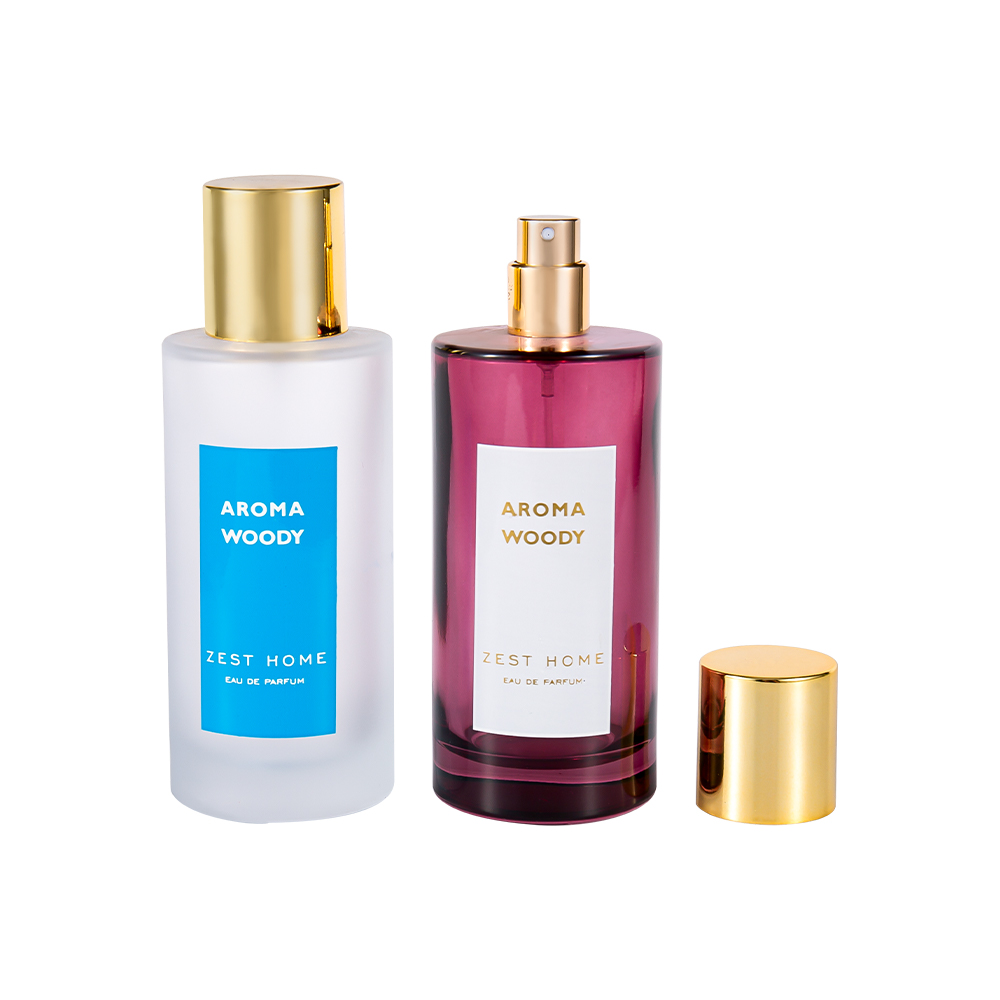 Classic Frosted 100ml Perfume Bottle with Gold Top for Premium FragranceThis 100ml frosted bottle with a luxurious gold top complements the premium glass aesthetic discussed, offering a refined matte finish that masks the refill mechanism while maintaining a timeless, high-end look.View Product →
Consumers routinely rank glass as the most premium packaging material. In fragrance packaging surveys, glass outperforms plastic on perceived quality by a wide margin, and a refillable glass shell keeps that halo effect intact. The decorative range is broad: a refillable bottle can carry a gradient-coated finish with a gold hot-stamped logo, a matte black treatment with an embossed pattern, or a clear glass shell with a minimal gold cap.
Sustainable luxury also depends on surface protection. A UV-protective coating preserves both the color of the bottle and the fragrance inside, which is critical when a consumer keeps the same glass for years. Aluminum or gold hot stamping, gradient coating, and frosted finishes turn a refillable bottle into an object the customer wants to keep.
The performance of a refillable bottle is decided by three technical parameters: neck standard, closure size, and glass wall thickness. HJ Glass Factory typically processes refillable perfume bottles on 18mm, 20mm, and 24mm neck finishes, with thread profiles that accept standard crimp or screw pumps. The glass wall must be thick enough to resist cracking when the consumer presses a refill cartridge into place, but not so thick that the bottle becomes uneconomical to ship.
Tolerances matter. The gap between the refill cartridge and the inner wall of the glass is controlled to roughly 1.0 to 1.5mm so the cartridge slides in without rattling. The closure torque for a screw-on collar is specified together with the pump supplier, because overtightening can crack the glass or strip the thread. HJ Glass Factory develops the mold and the cap in parallel to avoid these issues.
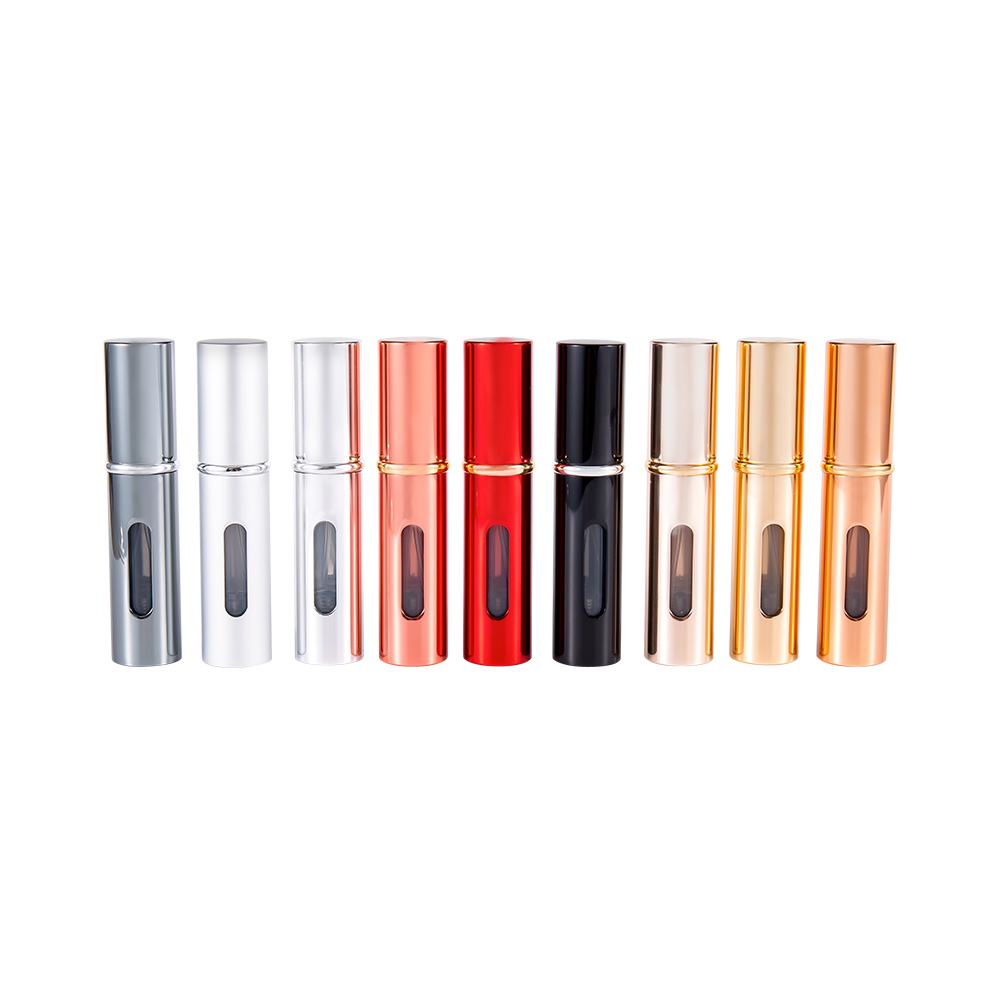 5ml Flat Bottom Aluminum Refill Perfume Bottle with Customizable LogoThis compact 5ml aluminum refill bottle suits refillable systems by providing a stable, lightweight cartridge option, with customizable colors and logos to align with brand identity and the refill experience.View Product →
Cap materials also shape the refill experience. ABS, PP, Surlyn, K-resin, PCTA, PE, and acrylic each offer different levels of rigidity, gloss, and chemical resistance. Surlyn and acrylic provide the glass-like clarity that luxury brands favor; ABS and PP offer robust snap-fit interfaces for repeated opening. A refillable design is only as good as its weakest seal, so the cap and collar must be specified together.
A refillable bottle costs more upfront but lowers the per-use packaging cost after the third refill. This is the economic turning point that most fragrance brands evaluate before committing to a refillable launch. The following table compares the most important procurement and consumer factors side by side.
| Criteria | Single-Use Glass Bottle | Refillable Glass Bottle |
| Initial tooling and assembly cost | Lower | Higher |
| Cost per filled unit after 3rd refill | Higher | Lower |
| Packaging waste per fill | Highest | Lowest |
| Consumer retention and repeat purchase | Moderate | High |
| Perceived luxury on the shelf | High | High |
| Compatibility with travel-size formats | Limited | Strong |
Below are the questions procurement teams and product developers ask most often when they consider a custom refillable perfume bottle.
A well-designed refillable glass bottle can be refilled 5 to 10 times without visible wear when the glass wall is thick enough and the refill cartridge is inserted smoothly. The limiting factor is usually the pump or collar seal, which can be replaced.
No. The perfume concentrate stays in a sealed cartridge inside the glass shell, protected from light and air. The glass shell and a UV-protective coating extend freshness because they block ultraviolet light that can degrade fragrance molecules.
Refillable designs become cost-effective for brands that can commit to a minimum of 5,000 to 10,000 units per SKU. The higher tooling and assembly cost is offset by improved repeat-purchase rates and reduced per-unit packaging expense after several refill cycles.
Brands should specify the neck finish, capacity, cap material, glass wall thickness, and the decorative finish. Working with a manufacturer that supports mold development and multi-step finishing ensures the refill mechanism and the aesthetic treatment are integrated from the start.


+86 151 9036 6355
+86 510 8627 8328

hjglassfactory@vip.163.com

Room 1304, Jiufang Plaza, No. 286, Hongqiao South Road, Jiangyin City, Jiangsu Province, China
Copyright © 2025 HJ Glass Factory
All Rights Reserved.
Wholesale Empty Perfume Bottles, Empty Aromatherapy Bottles