English
 Español

Industry News
Home / News / Industry News / Why Reed Diffuser Bottles Need the Right Glass Weight | HJ Glass Factory
Nov 09, 2026
Content
A 200 ml reed diffuser that weighs 320 g empty will shrug off a nudge from a housekeeping cart. The same bottle at 180 g will fall over. Reed diffuser bottle glass weight is the first number a buyer should lock down, because it decides three things at once: whether the bottle stays upright on a retail shelf, how quickly the oil leaves the reservoir, and what it costs to move 20,000 units from the filling line to a warehouse in Rotterdam.
Empty glass weight decides stability first, interior volume second, and freight cost third, in that order of importance.
Reed diffuser bottle glass weight is the mass of the container as it leaves the annealing lehr: no cap, no reeds, no oil, and, in a well-written specification, no decoration either. Every gram sits either in the base or in the wall, and those two locations do completely different jobs. Base glass is ballast that fights tipping. Wall glass is displacement that shrinks the space left for oil.
| Capacity | Typical empty weight | Wall thickness | Base diameter | Best-fit scenario |
| 100 ml | 180 - 220 g | 2.5 - 3.0 mm | 45 - 55 mm | Bathroom shelves, compact gift sets |
| 150 ml | 240 - 300 g | 3.0 - 3.5 mm | 55 - 65 mm | Desks, bedside tables, spa rooms |
| 200 ml | 320 - 400 g | 3.5 - 4.0 mm | 60 - 75 mm | Retail hero SKUs, hotel corridors |
| 500 ml | 700 - 900 g | 4.0 - 5.0 mm | 80 - 95 mm | Lobbies, showrooms, long burn cycles |
Thickening a wall from 2.8 mm to 4.2 mm on the same 68 mm footprint removes roughly 35 ml of usable oil, because the exterior stays locked while the interior cavity narrows on every side. That is the trade a heavier bottle makes: more stability, less liquid.
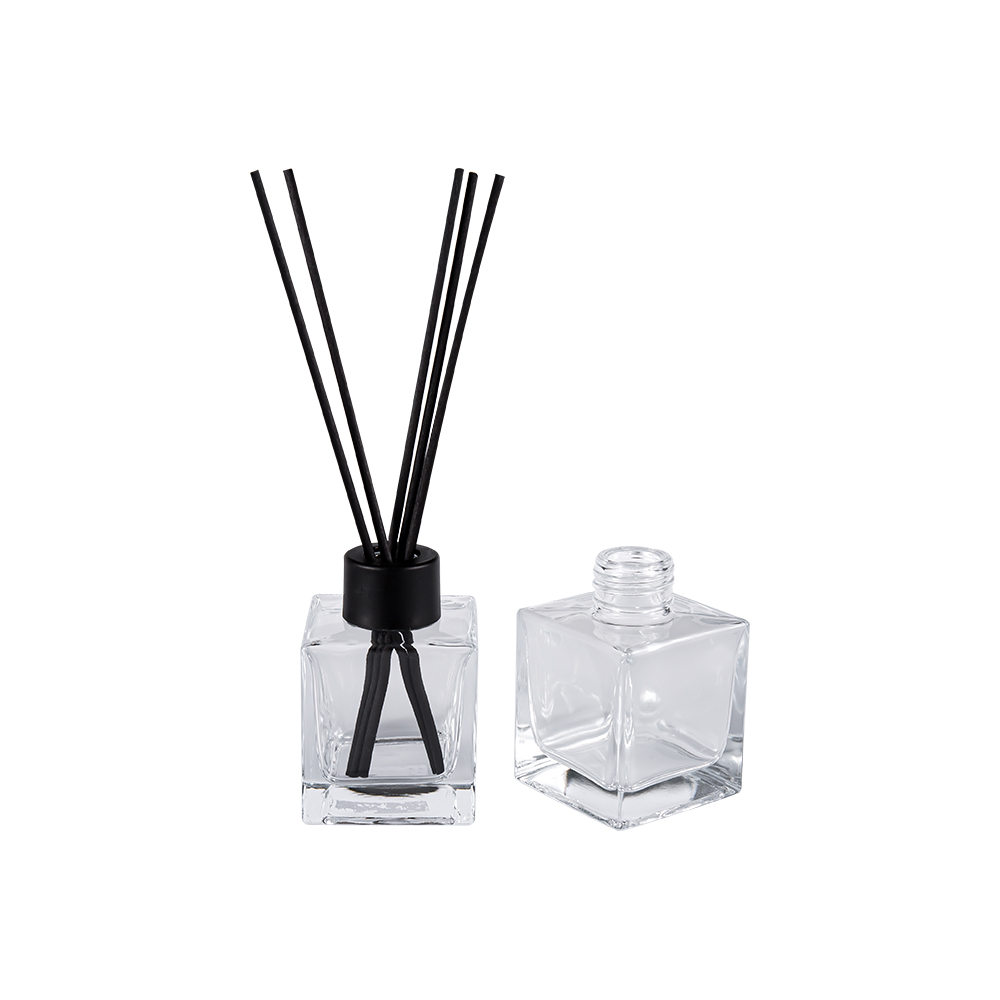 HJ-0309# Square Glass Aromatherapy Bottle 24MM Matte Black Plastic Cap Aluminum Cap Fiber The HJ-0309# square glass aromatherapy bottle features a sleek design. It comes with a 24mm matte black plastic cap. Extra-wide mouth allows fast in-store refills with...View Product →
A reed diffuser tips when its combined centre of gravity passes beyond the outer edge of its base, and because the oil column sits above the base, extra liquid adds very little stability while extra base glass adds a great deal.
Take a 200 ml bottle with a 70 mm base diameter carrying 170 g of oil and eight 250 mm fibre reeds. At 180 g of empty glass the combined centre of gravity sits about 62 mm above the table and the bottle tips at roughly 17 degrees of tilt. Adding 60 g of glass in the base alone lowers the centre of gravity by about 9 mm and raises the tipping angle to 23 degrees. Anyone who has watched a cleaning trolley clip a lobby diffuser understands why that six-degree margin earns its freight cost.
Reed height matters as much as glass mass. A 24 mm screw neck typically carries six to eight reeds, while a 28 mm neck takes ten to twelve, and the taller, denser cluster works like a lever arm. A 28 mm format therefore needs proportionally more base glass to hold the same tipping angle, which is why large-format diffusers are rarely sold under 300 g.
Heavier glass does not strengthen scent throw; it slows and steadies it, because thicker walls reduce the oil volume and the liquid surface area available inside the same exterior footprint.
Work the arithmetic on one mold. A cylindrical 200 ml diffuser with a 68 mm outer diameter holds about 205 ml of oil when the wall is 2.8 mm thick, and about 168 ml when the wall is 4.2 mm. The shallower pool also exposes roughly 11 percent less liquid surface, so at a constant evaporation rate a 60-day burn stretches to about 69 days. The trade-off is real: rooms above 20 square metres will notice a softer first-week throw from the heavy version.
Three variables move wicking faster than glass weight does:
For buyers building a range, the practical conclusion is simple. Pick the wall thickness that gives the burn time the brand promises, then add base glass until the tipping angle passes the stability test. Weight that serves neither goal is freight you pay for twice, once at the factory and once again on the invoice.
Under air freight, 50 extra grams per bottle is a real line item; under sea freight inside a fixed carton, it is usually free until the carton hits its handling limit.
Cost tracks chargeable weight, so the 1,000 kg above becomes roughly 4,500 USD on a single order. Specify 180 to 220 g bottles for 100 ml formats and confirm carton compression strength.
Cost tracks cubic metres, not kilograms. A heavier bottle in the same carton ships at the same price until the 20 to 22 kg handling limit is reached, so stability is effectively free on this route.
Square and rectangular formats with a 24 mm screw neck are the usual compromise: a wider footprint spreads the same glass mass over a larger contact area, which raises the tipping angle without adding grams. That geometry, not extra material, is where a well-designed reed diffuser glass bottle guide usually starts.
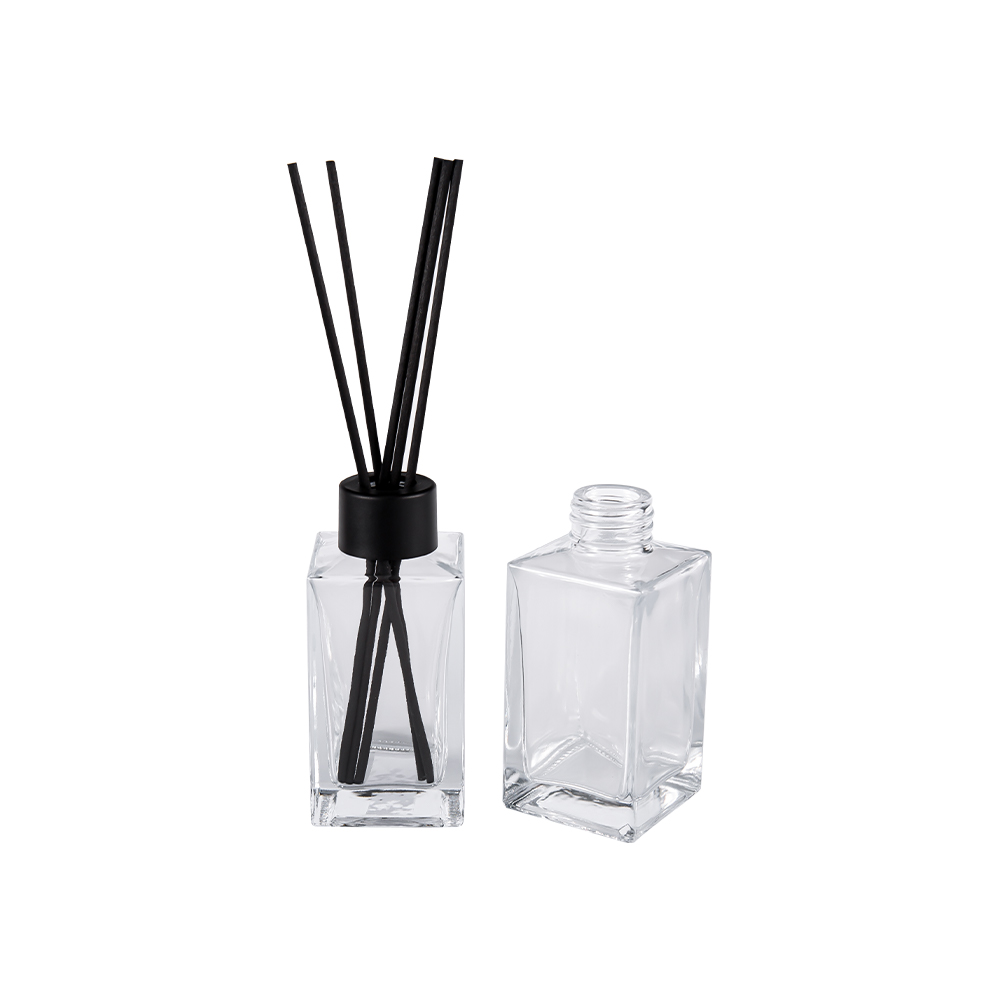 HJ-8199# Rectangular Glass Aromatherapy Bottle with 24mm Screw Neck and Aluminum Cap with The HJ-8199# rectangular glass aromatherapy bottle features a rectangular glass body and a spiral neck for easy tightening. It comes with a 24mm aluminum cap, a combin...View Product →
The target weight matters less than the tolerance band around it: a 5 percent allowance on a 320 g bottle gives the filling line anything from 304 g to 336 g.
That spread is invisible in amber or coated glass and glaring in clear glass, where a 16 g difference shifts the oil line several millimetres. Checkweighers reject more units, and net-content declarations drift when the customer buys by weight rather than by volume.
Decoration adds weight after the glass is finished, which is why a spec written on bare glass fails at the packing station. Spray coating, UV coating and electroplating each add a measurable layer, while hot stamping and printing add almost nothing.
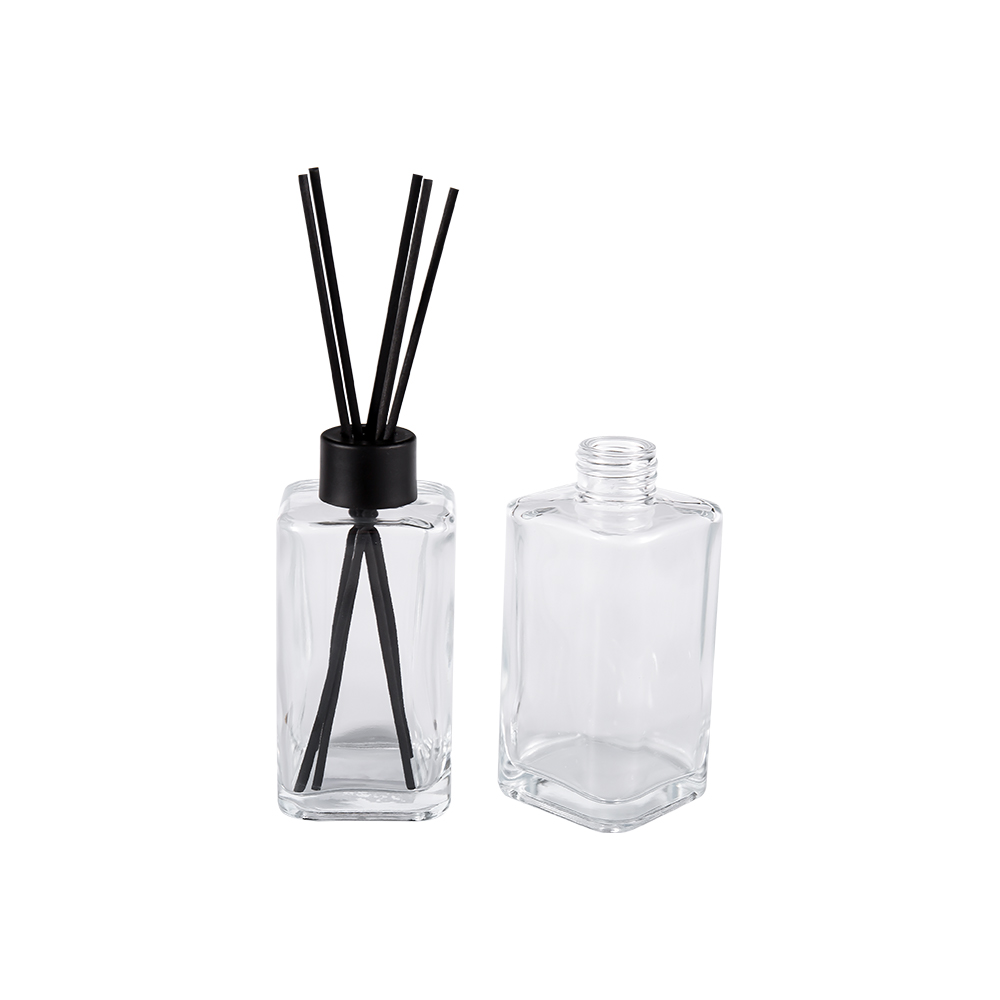 HJ-RX2247 Clear Glass Aromatherapy Bottle Large Capacity Matte Black Bottle Cap Aluminum CThe HJ-RX2247 clear glass aromatherapy bottle features a large capacity, perfect for holding a large volume of liquid. It comes with plastic cap or and an aluminum cap...View Product →
No, 180 to 220 g works well for a 100 ml bottle with a 45 to 55 mm base and five or six reeds. Problems start below 150 g, where a full oil load pushes the centre of gravity high enough that ordinary shelf contact knocks the bottle over.
The opposite. Thicker walls reduce interior volume and liquid surface area, so the same exterior size holds less oil and releases it more slowly. Heavier glass buys stability and a more even burn, not a stronger throw.
A 100 ml narrow-neck bottle typically lands between 190 g and 230 g, a 150 ml format between 250 g and 300 g, and a 200 ml format between 320 g and 390 g, all measured empty and before decoration.
Yes. Weight spread is controlled by gob weight, mold temperature and annealing consistency, so a supplier with in-house mold development can usually hold a tighter band after the first production run, provided the tolerance is written into the purchase specification.


+86 151 9036 6355
+86 510 8627 8328

hjglassfactory@vip.163.com

Room 1304, Jiufang Plaza, No. 286, Hongqiao South Road, Jiangyin City, Jiangsu Province, China
Copyright © 2025 HJ Glass Factory
All Rights Reserved.
Wholesale Empty Perfume Bottles, Empty Aromatherapy Bottles